
Emergency Retaining Wall Repair Richmond: Response for Collapsed, Failing & Actively Moving Walls
A collapsed retaining wall leaves unsupported soil, and unsupported soil keeps moving. The first priority is making the area safe, not assessing what it will cost to fix.
- Keep people and vehicles away from the top and the base
- Do not load the ground above the wall, including parking on it
- Photograph the wall and the surrounding area before anything moves
- Note whether movement is ongoing, and tell us when you call
Stabilization and rebuild are two different jobs with two different timelines. The first makes the site safe and buys time. The second corrects the cause and reinstates the wall. Treating them as one job is how people end up rebuilding on the same failed design.
We stabilize first and quote the rebuild second, because rebuild pricing cannot honestly come from photographs of a collapse. What caused the failure is under the rubble, and it determines the scope.
Is a wall down or moving right now?
Call us now for the fastest response. Tell us what is above and below the wall and whether it is still moving.
Request emergency help or call (804) 409-8197
What to Do Before We Arrive: Safety, Access & Documentation
While you wait for us, a few steps matter more than anything else, in this order. Keep everyone off both the top and the base of the wall, then photograph the damage from a safe distance. Those photos help both the rebuild and any insurance claim.
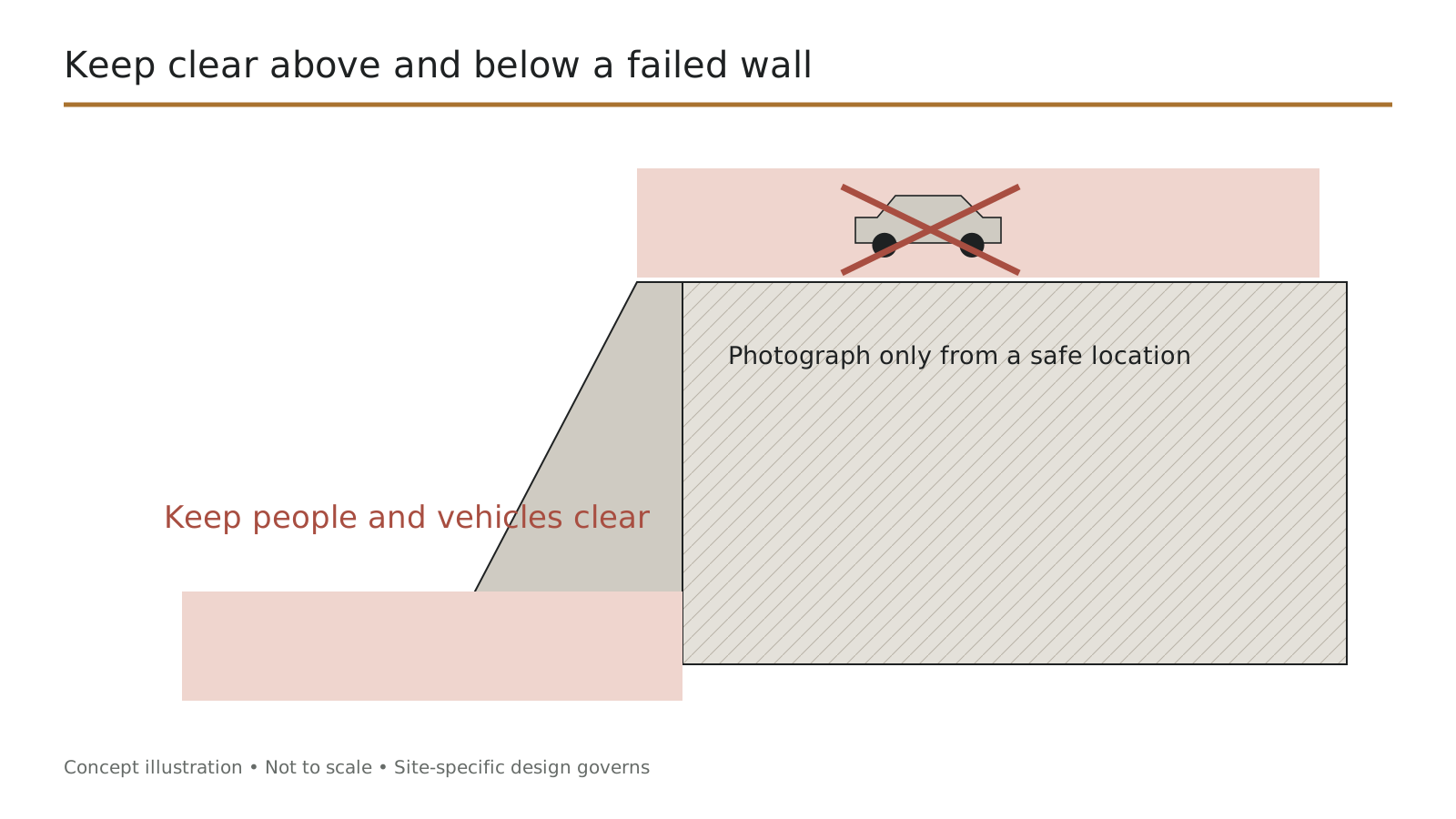
- Clear the area. Both sides. People instinctively keep away from the base and then stand on the ground above it, which is the part that is now unsupported.
- Stop loading it. Move vehicles off any driveway or parking area above the wall. Do not stack the failed material anywhere near the top.
- Do not push material back. Attempting to reposition collapsed blocks or ties can release more soil. Leave it where it is.
- Photograph everything. The wall, the ground above and below, any cracks in nearby hardscape, and the wider site. Date-stamped photos matter for insurers and for scoping.
- Note whether it is moving. Mark the position of a displaced section and check it. Ongoing movement changes how we respond and how quickly.
- Check what is downhill. A structure, a driveway, a utility or a neighbor's property below the wall raises the urgency considerably. Tell us when you call.
Emergency & Collapsed Retaining Wall Repair Costs in Richmond, VA
Emergency work is priced in three separate parts, because they are three separate jobs and bundling them hides what you are paying for.
| Stage | What it covers | Planning range | Notes |
|---|---|---|---|
| Emergency response and assessment | Rapid site visit, hazard assessment, advice | $250 – $750 | After-hours and weekend rates stated plainly on the call |
| Temporary stabilization | Shoring, slope protection, debris containment | $1,500 – $6,500 | By height and length of exposed soil |
| Debris removal | Clearing and disposing of failed material | $400 – $2,200 | Treated timber and ties cost more to dispose of |
| Permanent rebuild | Corrected base, drainage, new wall | Per the relevant system page | Cannot be quoted from photographs of a collapse |
Planning ranges based on published 2026 national cost averages for comparable work (HomeGuide, HomeAdvisor), not quotes. Rebuild pricing follows once the cause is visible. Last reviewed: September 2026.
Why we will not quote the rebuild over the phone
What caused the failure is underneath the collapsed material. Until that is cleared we cannot see whether the base failed, the drainage failed, the wall was under-designed for its loading, or the slope itself is moving. Anyone giving you a firm rebuild figure from photographs is guessing, and the revision comes later.
How We Stabilize the Site & Rebuild the Wall
- 1
Phone triage
What has happened, what is above and below the wall, whether it is still moving, and whether weather is coming. This determines how fast we need to be.
Temporary stabilization makes the site safe before the rebuild. - 2
Rapid site visit
Hazard assessment and immediate advice. If the area is not safe, making it safe comes before anything else.
- 3
Temporary stabilization
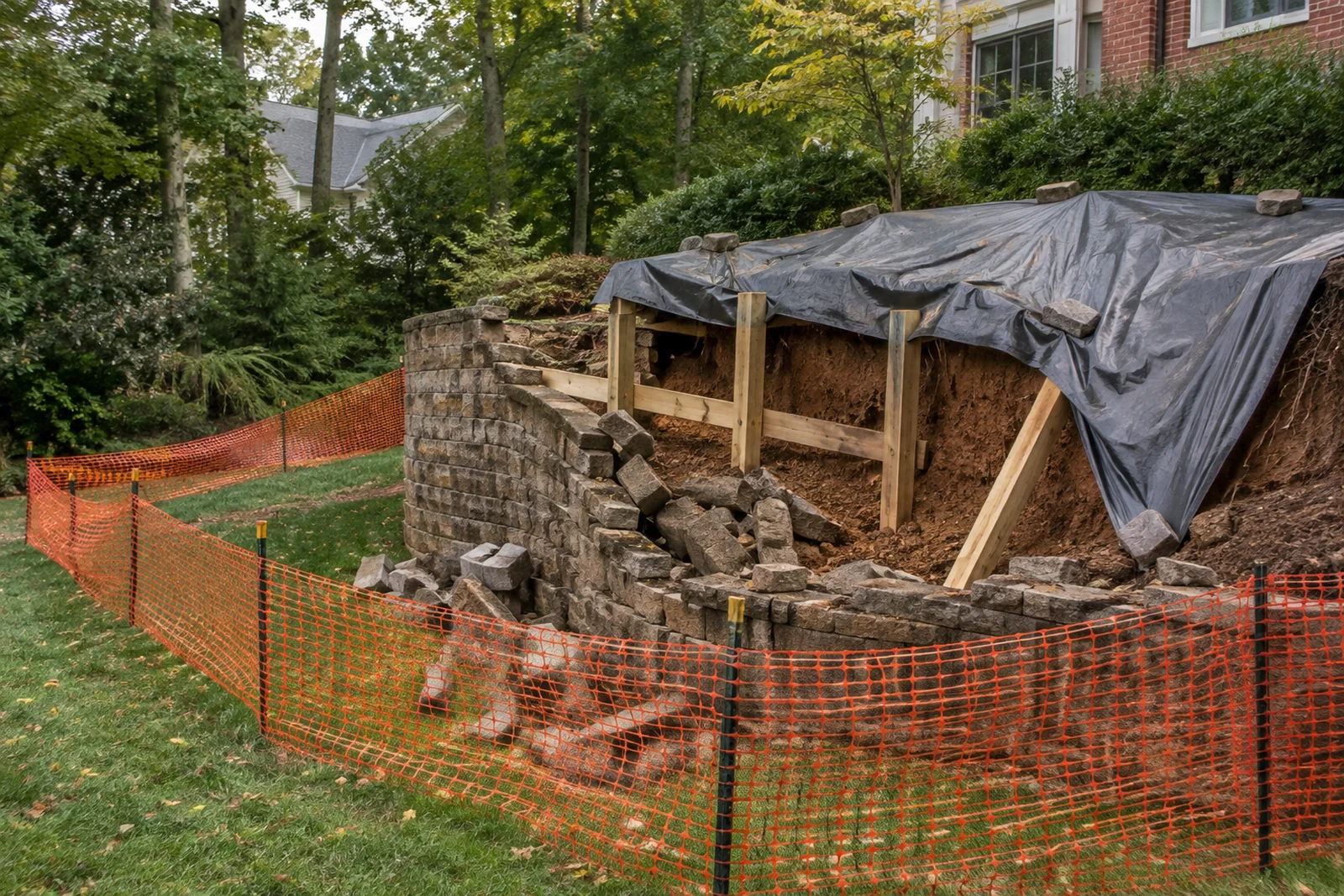
Shoring, slope protection and containment so the site holds while a proper scope is developed. This is a separate job from the rebuild.
- 4
Debris clearance
Failed material removed and disposed of. Treated timber and creosote ties go to a facility that accepts them.
- 5
Cause identification
With the rubble gone, what actually failed becomes visible. This drives the rebuild design.
- 6
Permits and engineering
Confirmed for the rebuild. A collapse frequently means the original design was inadequate, which is an engineering conversation.
- 7
Rebuild
Corrected base, real drainage with a working outlet, reinforcement where the original lacked it.
- 8
Restoration and walkthrough
Grade restored, site cleaned, and documentation of what failed and what changed.
Protecting Your Home, Driveway, Utilities & Neighboring Property
A collapsed wall is rarely only a wall problem. What it was holding up is now unsupported, and that has consequences.
- Structures above. A house, garage or deck founded on ground that the wall was retaining needs assessing urgently. This is the situation where an engineer gets involved immediately rather than eventually.
- Driveways and parking. Pavement above a failed wall can be undermined without showing it from the surface. Keep vehicles off until it has been looked at.
- Buried utilities. Services running through the retained soil can be exposed or damaged by the movement. If you see or smell anything, treat it as a utility emergency first and a wall problem second.
- Neighboring property. Soil, water and debris crossing a boundary creates both a practical and a legal problem. Documenting it early protects you.
- Downhill structures. Anything below the wall is in the path of whatever moves next. This raises urgency more than anything else on the list.
- The rest of the wall. A section that failed usually indicates a condition affecting the whole run. We assess the remainder rather than only the gap. See inspection and assessment.
Emergency Permits, Insurance Claims & Engineering Review in Richmond, VA
Emergency work still falls under the same permit rules as any other wall, and most walls tall enough to fail dangerously need a permit for the rebuild. Insurance comes up on nearly every call. We document the failure and its likely cause so you have what the adjuster will ask for.
- Permits. The Virginia Uniform Statewide Building Code exempts retaining walls supporting less than three feet of unbalanced fill from permit application. The exemption does not apply where the wall supports a surcharge other than ordinary unbalanced fill. A rebuild after a collapse is generally treated as new construction, and localities have processes for urgent work. We handle it.
- Insurance, honestly. Coverage depends entirely on cause and policy. Gradual failure from water and soil pressure is commonly excluded as wear. Sudden damage from a specific covered event is sometimes included. We document what we find in writing, which is what an adjuster will want either way.
- Do not clear everything first. Photograph before clearing. Adjusters want to see the condition as found, and a cleared site is harder to assess.
- Engineering. A collapse usually means the original design was inadequate for the loading. Rebuilding to the same design repeats the outcome, which is why stamped design is common on rebuilds.
- Neighbor notification. If the failure has affected or threatens adjacent property, telling them early is both practical and protective.
- Land disturbance. Emergency stabilization and a rebuild can cross land disturbance thresholds, which are lower in Chesapeake Bay Preservation Areas than elsewhere in Virginia.
We confirm current thresholds with the building office for your address before quoting. Detail by jurisdiction is on our permits and requirements page.
Emergency Retaining Wall Repair FAQs
Does Richmond weather make wall collapses more likely?
Yes. Inland rainfall from tropical systems can drop several inches in hours, and that's what most often turns a leaning wall into a sudden collapse.
Do you respond across the whole Richmond metro, not just the city?
Yes, including Henrico, Chesterfield, Hanover and the Tri-Cities. Tell us your location when you call and we'll give you a real estimate of arrival time.
How quickly can you get here?
It depends on where you are and what else is running, and we will tell you a real time on the phone rather than an optimistic one. Tell us what is above and below the wall and whether it is still moving.
Will homeowners insurance cover a collapsed retaining wall?
It depends on cause and policy. Gradual failure from water and soil pressure is commonly excluded as wear and tear.
Can you stabilize it now and rebuild later?
Yes, and that is frequently the right sequence. Stabilization makes the site safe and buys time to scope the rebuild properly, arrange engineering and deal with insurance.
Is the rest of the wall going to fail too?
Often, and it is worth finding out. A section that failed usually indicates a condition affecting the whole run, because the wall was built at once in the same conditions.
Do I need to notify my neighbor or the county?
If soil, water or debris has crossed a boundary, or if the failure threatens adjacent property, telling your neighbor early is both practical and protective. The county comes in through the permit for the rebuild, which we handle.
Get Emergency Retaining Wall Help
We stabilize the site first, then scope a rebuild that corrects the cause. We measure the site, explain what the ground needs, and give you a written price with every line item shown.
- Rapid site response
- Temporary stabilization
- Insurance documentation
- Rebuilt to a corrected design
Serving Richmond, Henrico, Chesterfield and Hanover, plus Petersburg, Hopewell, Colonial Heights, Powhatan, Goochland and Prince George County.