
Retaining Wall Inspection Richmond: Inspections for Homeowners, Buyers, Sellers & Property Managers
Four people call us for inspections. The homeowner who noticed the wall leaning or a crack widening. The buyer whose home inspector flagged the wall and excluded it from their own report. The seller documenting condition before listing. And the HOA or property manager budgeting across multiple walls.
- Most general home inspection standards exclude retaining walls, which is why you were told to call a specialist
- An inspection costs a fraction of a rebuild and frequently prevents one
- The deliverable is written, photographed and usable with an insurer or a board
- We inspect walls regardless of who built them
The buyer case is the most time-sensitive and the most common. A home inspector notes a retaining wall as beyond their scope, the buyer has days rather than weeks, and somebody needs to say whether this is a $1,200 drainage fix or a $25,000 rebuild. We schedule around closing dates.
We charge for a diagnostic assessment, because investigating a failure is different work from measuring for a quote. Quotes on new work are free. Finding out why an existing wall moved takes time and it produces a document you can use.
Need to know what is actually wrong with a wall?
Contact us today to book an inspection. We tell you the fee before you book and whether it is credited toward the work.
What We Look For: Movement, Drainage, Materials & Base Condition
An inspection works through the causes in order, not just the visible symptoms. We start with where the water goes, then check the base, the reinforcement and the wall material. Each finding goes into the written report with photos.
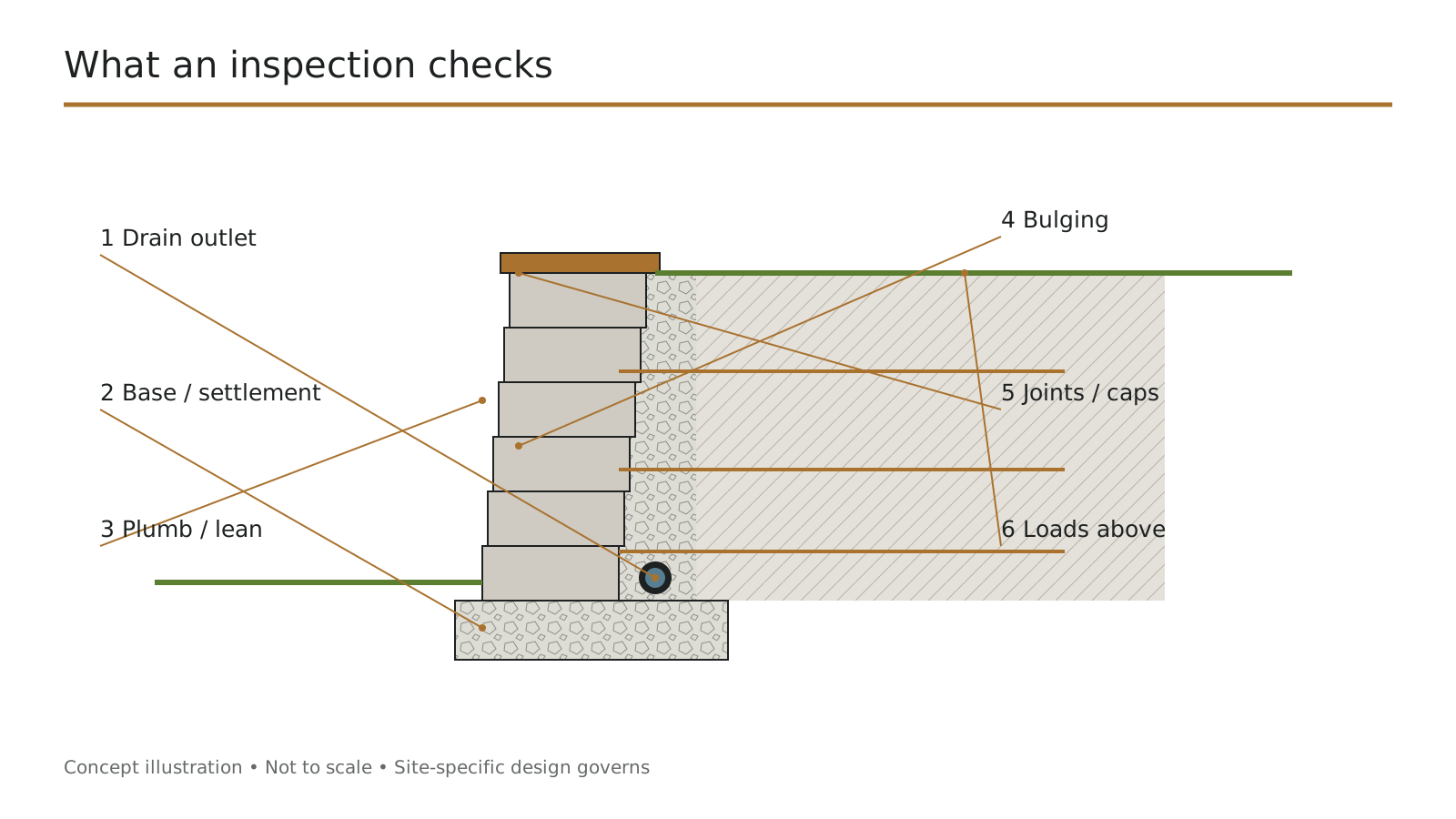
- Where the water goes. We look for the drain outlet first. A retaining wall drain that has silted shut, rooted over or was never given a real outlet is the most common cause we find anywhere in this metro.
- What the base is sitting on. Settlement at one end, a dip in the top course or a wall that has rotated forward as a unit all point downward rather than backward.
- Whether reinforcement exists. Many taller walls in this region were built as gravity walls when they needed geogrid. That shows as leaning that worsens toward the top.
- What is loading the wall. A driveway, parked vehicle, shed or patio added above a wall never designed for it. Loads added years after construction are a common and under-recognized cause.
- How old the material is. Treated timber, railroad ties and unreinforced masonry have finite lives. At end of life, repair stops being economical regardless of workmanship.
How Much Does a Retaining Wall Inspection Cost in Richmond, VA?
Inspections are priced in flat-fee tiers rather than by wall size, because the variable is complexity rather than dimensions. A short complicated wall takes longer to diagnose than a long simple one.
| Inspection type | What it covers | Planning range | Notes |
|---|---|---|---|
| Single residential wall | Site visit, measurements, photos, verbal findings | $150 – $450 | Often credited toward work if you proceed |
| Multi-wall or tiered system | Several walls or a tiered arrangement assessed together | $400 – $900 | Tiers interact, so they are assessed as one system |
| Commercial or HOA property survey | Property-wide condition survey with priorities | $700 – $2,400 | Priced by wall count and property size |
| Written report | Formal document with photos and ranked options | $0 – $250 | Sometimes included, sometimes separate. We say which on the call |
| Engineer's stamped evaluation | Licensed professional structural analysis | $500 – $2,500 | Pass-through cost, arranged where required |
Planning ranges based on published 2026 national cost averages for comparable work (HomeGuide, HomeAdvisor), not quotes. We tell you the fee on the phone before booking. Last reviewed: September 2026.
Why the fee exists
Quotes on new construction are free because measuring a slope takes fifteen minutes. Diagnosing why an existing wall moved is investigative work, and it produces a document you can hand to an insurer, a board or a buyer's agent. Charging for it is also what keeps the finding honest. A contractor who only earns money by selling you a rebuild has a reason to find one.
How the Inspection Works From Site Visit to Written Report
- 1
Booking and timeline
We tell you the fee and confirm your deadline. Closing dates and board meetings drive scheduling more than anything else.
- 2
Site visit and measurement
Wall dimensions, the extent and direction of any movement, drainage condition, base condition where visible, and what is loading the wall from above.
- 3
Photographic record
Documented from consistent positions so the record is usable later for comparison.
- 4
Cause identification
What happened and why. This is the part that distinguishes an inspection from a look.
- 5
Activity assessment
Whether movement is ongoing or has stabilized. This determines urgency more than the visible damage does.
- 6
Written findings and options
Findings, cause, and options ranked by cost, from monitoring through to replacement.
- 7
Handover and monitoring advice
We walk you through it and show you a straightforward way to keep watching the wall yourself.
Reading Your Report: Monitor, Repair or Replace
Every report lands on one of three recommendations, and the difference between them is frequently tens of thousands of dollars of work.

- Monitor. The wall has moved historically but shows no sign of current activity, and the cause is not ongoing. We give you a marking and photography method so you can track it yourself and call us if it changes.
- Maintain. The wall is sound but its drainage has stopped working, its caps have shifted, or vegetation is getting into the joints. Usually the cheapest meaningful intervention. See maintenance, cleaning and sealing.
- Repair. A defined cause affecting part of the wall, correctable without taking the whole thing down. See retaining wall repair.
- Replace. Movement along most of the length, a failed base, or material at end of life. See retaining wall replacement.
- Escalate. Some conditions need a licensed professional engineer rather than a contractor's assessment. We say so plainly rather than proceeding beyond what we should.
When Your Wall Requires a Licensed Engineer in Richmond, VA
There is a real line between what a contractor can properly assess and what requires a licensed professional engineer. We are clear about where it sits.
- What we assess. Condition, apparent cause, drainage performance, material state, and whether movement is active. That covers the majority of residential calls.
- What needs an engineer. Structural analysis, stamped evaluation for a lender or insurer, global slope stability on a steep lot, and any wall where the question is load capacity rather than condition.
- Why home inspections exclude walls. General home inspection standards of practice typically place retaining walls outside their scope. That is why buyers are told to call a specialist, and it is not a sign anybody did anything wrong.
- Permit context. The Virginia Uniform Statewide Building Code exempts retaining walls supporting less than three feet of unbalanced fill from permit application. The exemption does not apply where the wall supports a surcharge other than ordinary unbalanced fill. A wall being assessed for repair may or may not cross that threshold once work is scoped.
- Reports for third parties. If a lender, insurer or board has specified what they need, tell us on the call. Whether our report satisfies it depends entirely on what they asked for.
We confirm current thresholds with the building office for your address before quoting. Detail by jurisdiction is on our permits and requirements page.
Retaining Wall Inspection FAQs
Do you inspect walls ahead of a Richmond-area home sale?
Yes, this is common when a buyer's inspector flags a wall as outside their scope. We schedule around closing dates across the metro, including tight timelines.
Can you assess multiple walls for a Richmond-area HOA in one visit?
Yes, communities like Brandermill with many original walls built at once are assessed together, with each wall rated and priced on its own.
Is the inspection fee credited toward repair work?
Frequently, and we confirm it on the call before booking rather than leaving it ambiguous. Where it is credited, it comes off the repair or replacement price if you proceed with us.
Can you inspect before my closing date?
Usually. Buyer inspections are the most time-sensitive work we do, and we schedule around closing dates rather than around our convenience.
Will the report satisfy my lender, insurer or HOA board?
It depends entirely on what they have asked for. Some want a contractor's condition report and some specify a stamped evaluation from a licensed engineer.
Can you inspect a wall your company did not build?
Yes, and most of the walls we inspect are ones we did not build. Charging a flat fee for the assessment is part of what keeps it honest.
How do I tell if the wall is still moving?
Mark it and watch it. A pencil line across a joint, a photograph from a fixed position, and a date.
Book a Retaining Wall Inspection
An inspection costs a fraction of a rebuild and often prevents one. We measure the wall, document the condition and give you options ranked by cost.
- Written findings with photos
- Scheduled around closing dates
- Walls we did not build
- Engineer referral when needed
Serving Richmond, Henrico, Chesterfield and Hanover, plus Petersburg, Hopewell, Colonial Heights, Powhatan, Goochland and Prince George County.