

Chester Retaining Walls: Services & Builds in Chester, VA
Residential Retaining Wall Installation in Chester
Most of Chester is flat enough that a casual look suggests there is no wall work here. The grade change is concentrated at the creek corridors, where lots back onto ravines and drop several feet over a short distance. Those are the walls that matter structurally.
Away from the corridors, wall work is definition and drainage. Raised beds, level planting areas, low spots built up, and the small grade changes around driveways and entries. See retaining wall installation for how we build both kinds.
Retaining Wall Repair, Replacement & Drainage
Chester's housing stock spans several decades and that creates two distinct streams of work side by side. Older neighborhoods carry timber and tie walls now at end of life. Newer construction carries walls that are structurally young but were sometimes built without adequate drainage or base preparation.
Commercial & Multifamily Retaining Wall Services
The Route 1 and Interstate 95 corridors through Chester carry steady commercial and light industrial development, which generates site walls, parking edges and loading area grade transitions.
Does your Chester lot back onto a creek?
Contact us today to schedule a free on-site retaining wall estimate. Tell us if the wall sits near Proctors Creek or Ashton Creek.
Start your free retaining wall estimate or call (804) 409-8197
Wall Materials & Site Constraints in Chester
Chester's sandy Coastal Plain ground rewards attention to the parts of a wall nobody sees. Sand digs quickly but won't hold a vertical face, and it washes into drainage stone without filter fabric. We compact every base carefully and wrap the drainage stone.
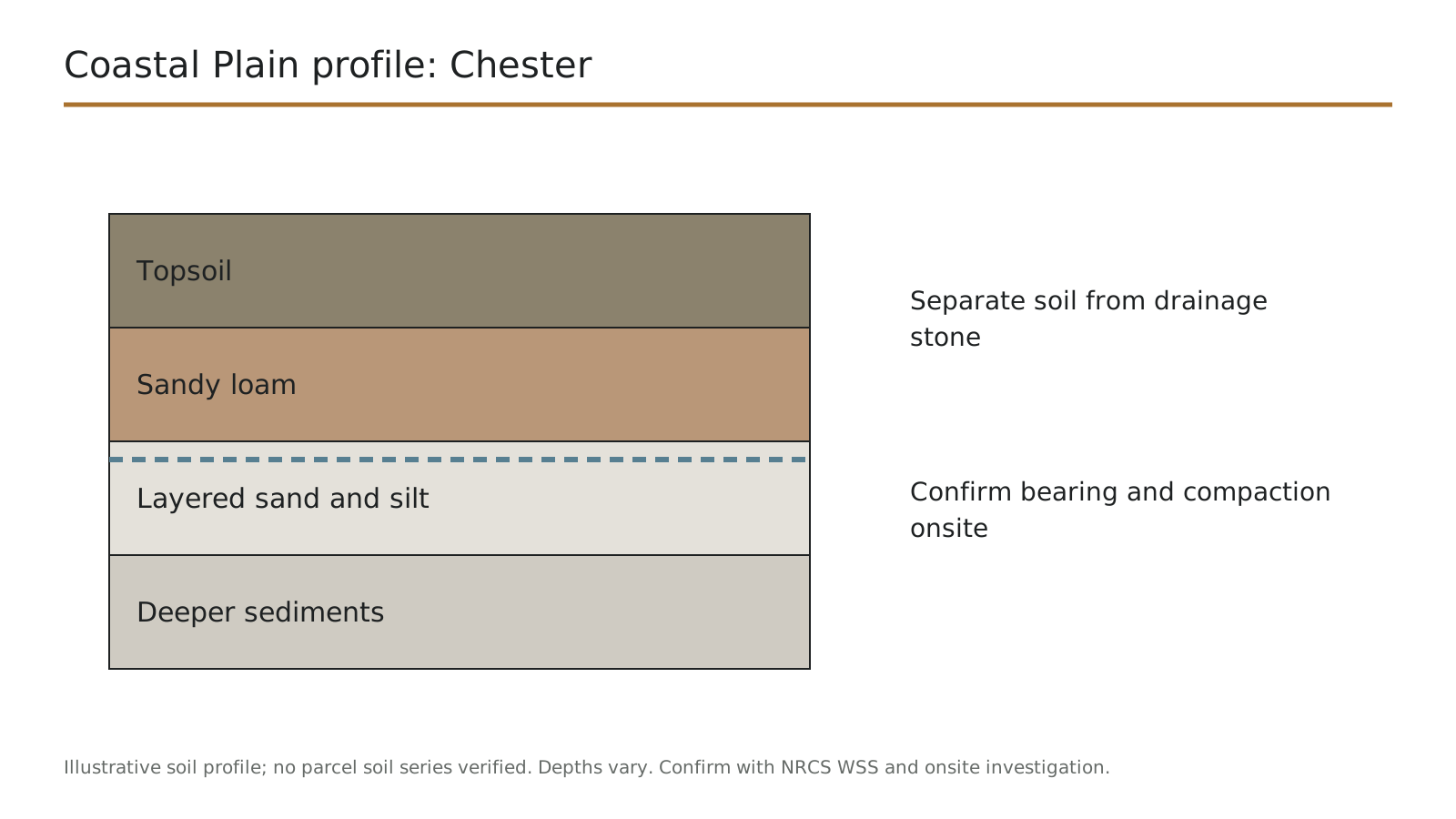
- Low cohesion sand. Digs quickly and predictably, and does not hold a vertical face. Temporary cuts need care and the base needs real compaction, because sand will not bridge across a soft spot.
- Migration into aggregate. Fine material moves into open-graded drainage stone readily. Geotextile separation prevents it. Its absence is the defect we find most often in older Chester walls, and it takes years to become visible.
- Creek-corridor stability. Lots backing onto ravines carry slopes that are actively eroding in places. A wall there is stabilizing ground rather than decorating it, and the design reflects that.
- Floodplain-adjacent parcels. Properties near Proctors Creek and Ashton Creek may sit in mapped floodplain. That is checked before design rather than discovered during permitting.
We check floodplain mapping on creek-adjacent parcels before designing anything, and we put geotextile between your sandy soil and the drainage stone. Both are steps that cost little now and cost a great deal to add later.
How Much Does a Retaining Wall Cost in Chester?
Chester pricing sits near the metro average. Access is generally workable and heights are moderate, so the variables are drainage integration and whether a creek-corridor slope needs stabilizing rather than just retaining.
| Project | Typical size | Planning range | What moves the number |
|---|---|---|---|
| Creek-corridor slope wall | 45 ft, 4 ft exposed | $7,800 – $17,500 | Slope stability, buffer and floodplain checks, access |
| Older timber or tie wall replacement | 35 ft, 3–4 ft exposed | $6,600 – $15,000 | Deadmen extraction, treated timber disposal |
| Drainage-driven wall with yard drainage integration | 35 ft plus drain run | $3,600 – $9,000 | Available fall, outlet distance, restoration |
| Commercial site or parking area wall | 100 ft, engineered | $21,000 + | Surcharge design, plan review, phasing |
Planning ranges based on published 2026 national cost averages for comparable work (HomeGuide, HomeAdvisor), not quotes. Final pricing follows a site visit. Last reviewed: September 2026. See the full Richmond metro cost guide for the line-item breakdown.
Estimate a wall in Chester
If your lot backs onto a creek, choose wet or poor-draining. Ground near those corridors behaves differently from the flat ground away from them.
How We Plan & Complete Your Retaining Wall Project in Chester
On creek-side parcels, our sequence front-loads one check that saves time later. Before designing, we verify floodplain mapping and any stream buffers, so the design doesn't have to change during permitting.
- 1
Site visit and slope assessment
Grade change, whether the slope is stable or actively eroding, and where water is going.
- 2
Floodplain and buffer verification
On creek-adjacent parcels we check mapping before designing, rather than discovering a constraint during permitting.
- 3
Design and material selection
Heights here are moderate, so the decisions are mostly about base, filtration and appearance.
- 4
Permits, where required
Confirmed with Chesterfield County for your address.
- 5
Utility locating
Virginia 811 notice before excavation, plus private irrigation and lighting lines identified with you.
- 6
Excavation and base preparation
Properly compacted aggregate base. In low-cohesion sand this is where the project succeeds or fails.
- 7
Wall, drainage and filtration
Courses to specification, aggregate zone with geotextile separation, pipe pitched to an outlet with real fall.
- 8
Restoration and walkthrough
Grade cleaned, spoil removed, discharge point shown so it can be kept clear.
If your property backs onto Proctors Creek or Ashton Creek, tell us early. Floodplain and buffer status is quicker to check before design than to work around afterwards.
Chester's Coastal Plain Sands, Creek Corridors & Low-Relief Drainage
Chester sits well east of the Fall Line, on unconsolidated sediment rather than on weathered rock. The terrain reads as flat and the wall work is concentrated in places where it is not.
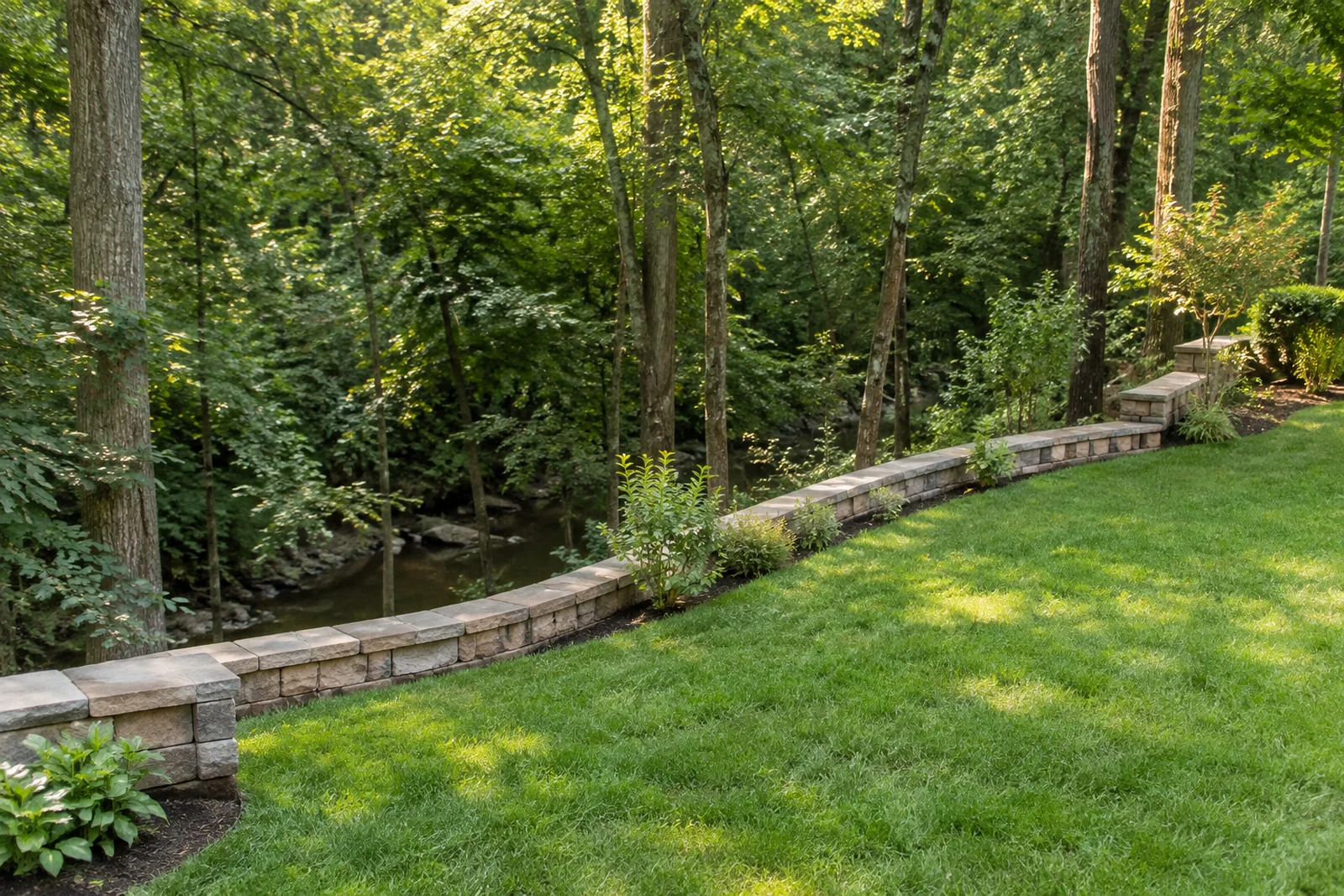
- Flat, with exceptions. Broad low relief across most of the area, cut by creek corridors where lots drop several feet over a short distance. Those corridors are where structural wall work concentrates.
- Sand digs easily. Excavation is quicker and cheaper here than on the Piedmont side of the metro, and rock is not a realistic concern. That shows up as lower excavation line items.
- Sand holds itself poorly. The same low cohesion means base compaction is not optional and temporary cut faces need care. Settlement, not leaning, is the characteristic local failure.
- Filtration prevents the slow failure. Fine sand migrates into unfiltered drainage aggregate and fills the voids over years. Geotextile separation is the component that stops it.
Mixed Housing Stock: End-of-Life Walls and New Construction Grading in Chester
Chester was built out in waves, and the wall work reflects that directly. Two different demand streams run side by side on neighboring streets.
- The older stream. Timber and railroad tie walls from earlier decades, now well past their service life. These fail from the inside, so surface condition understates how far gone they are. Replacement rather than repair is almost always the honest answer.
- The newer stream. Walls that are structurally young but were built to a developer's budget. Undersized drainage, thin base preparation and gravity construction where reinforcement was needed. These show up as settlement and seepage rather than collapse.
- Telling them apart. Material and construction era do most of the work. Timber is timber. A block wall that has settled unevenly but stands straight is a base problem. A block wall leaning progressively from the top is a reinforcement problem.
Chesterfield County Permits, Floodplain Mapping & Stormwater Review in Chester
Chester is unincorporated Chesterfield County, so the County is your permitting authority. Walls under three feet usually don't need a permit unless a driveway or structure sits above them. Creek-side lots can also need floodplain and stormwater review, which we check first.
- The state threshold. The Virginia Uniform Statewide Building Code exempts retaining walls supporting less than three feet of unbalanced fill from permit application. The exemption does not apply where the wall supports a surcharge other than ordinary unbalanced fill.
- Who administers it. Chesterfield County's building inspection and environmental engineering functions. We confirm current thresholds for your address before quoting.
- Floodplain verification. Parcels near Proctors Creek and Ashton Creek may sit within mapped floodplain, which carries its own requirements for structures. This is checked before design.
Retaining Wall FAQs for Chester Property Owners
My Chester property backs up to a creek. Does that limit where I can build?
It can. Creek-adjacent parcels may sit in mapped floodplain, and Chesapeake Bay Preservation Act buffers restrict land disturbance near designated waterways in designated localities.
Does Chester's sandy soil hold a wall as well as clay?
Differently rather than worse. Sand digs easily and drains quickly, which is helpful.
How do I find out if I'm in a floodplain?
FEMA flood mapping covers the creek corridors here, and Chesterfield County holds the local floodplain information. We check it as a standard step on creek-adjacent properties, and you can look it up yourself before calling if you want to know early.
My Chester neighborhood has walls from three different decades. What does mine need?
Material and era tell you most of it. Timber from earlier decades is almost always a replacement.
Can a wall fix water running through my backyard?
Sometimes, and often the right answer is a drain rather than a wall, or both. The question is whether the water is surface runoff, subsurface flow or roof discharge, because those look identical from the surface and need different solutions.
Request a Free Retaining Wall Estimate
Creek-side lots get floodplain checks before design. We measure the site, explain what the ground needs, and give you a written price with every line item shown.
- Creek-slope walls
- Tie wall replacement
- Floodplain checks
- Chesterfield County permits
Serving Chester, Rivers Bend, the Route 10 and Route 1 corridors and northeastern Chesterfield County.