
Retaining Wall Drainage Richmond: Solutions for Water Collecting Behind Your Wall
Every retaining wall holds back soil. Only some of them are also holding back water, and those are the ones that move. The job of a drainage system is to make sure the wall never has to carry water pressure in the first place.
- Saturated soil loads a wall far harder than drained soil does
- Filter separation is what keeps the aggregate zone working long term
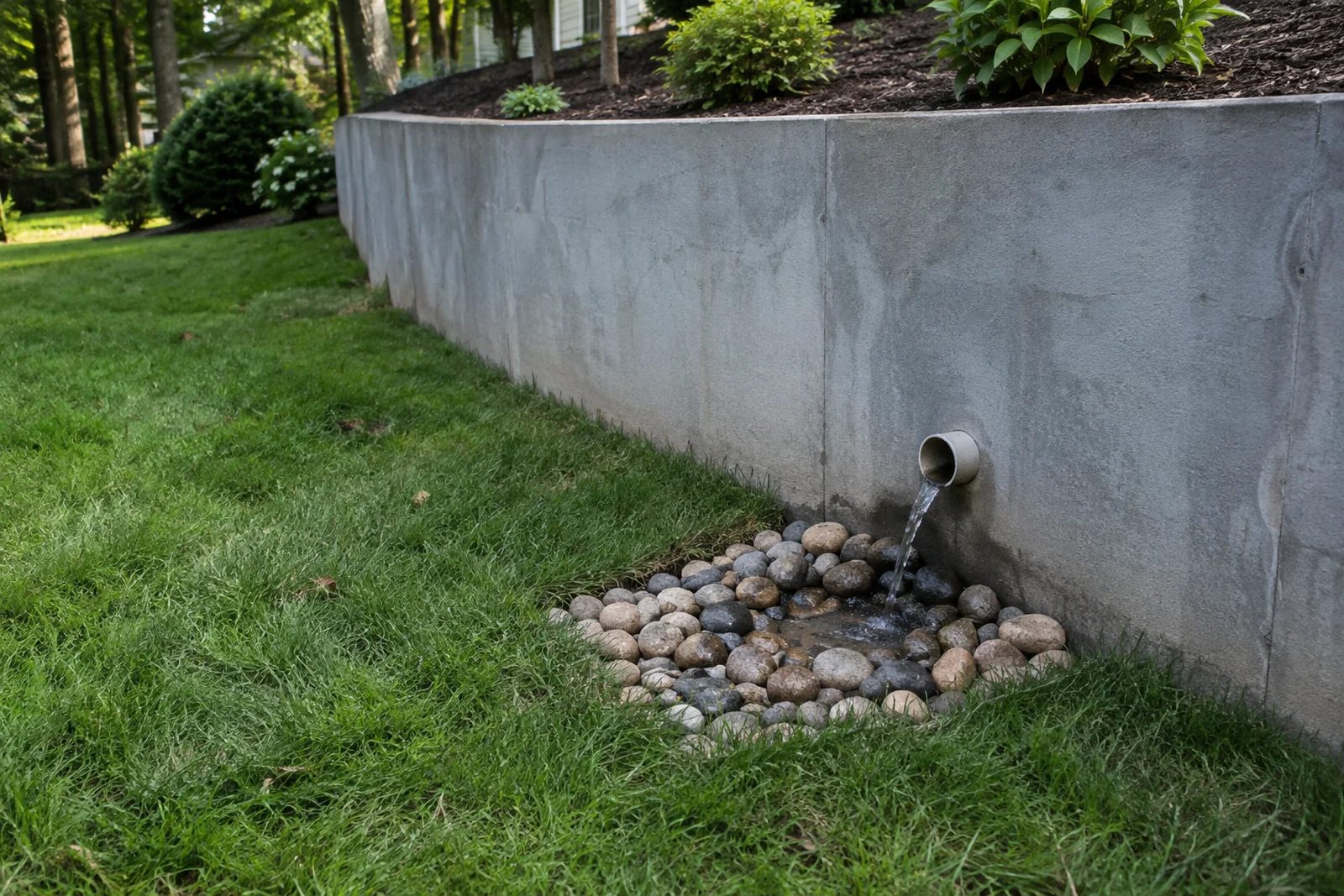
The signs are recognizable. Water seeping through the face after rain. Efflorescence staining. A wall that bulges in the middle rather than leaning uniformly. Soggy ground at the base that never quite dries. A drain outlet you cannot find because mulch and ivy covered it years ago.
Richmond's split geology changes what goes wrong. West of the Fall Line, Piedmont clay drains slowly and holds water against the back of a wall for days after a storm. East of it, Coastal Plain sand drains quickly and then migrates into the aggregate zone, silting up a system that was built without adequate filtration. Two different problems, one symptom.
We size the aggregate and the filter separation to the soil on your lot, then walk the property to find a discharge point with real fall. Where no gravity outlet exists, we say so before designing around one that is not there.
Retaining Wall Waterproofing in Richmond, VA
Nearly every retaining wall needs drainage. A much smaller number need waterproofing.
- Waterproofing goes on the back face, against the soil, not the visible side
- A coating applied to the exposed face is not waterproofing

Planning retaining wall waterproofing
This distinction is the whole page, and it is the thing most people calling about waterproofing have not yet made.
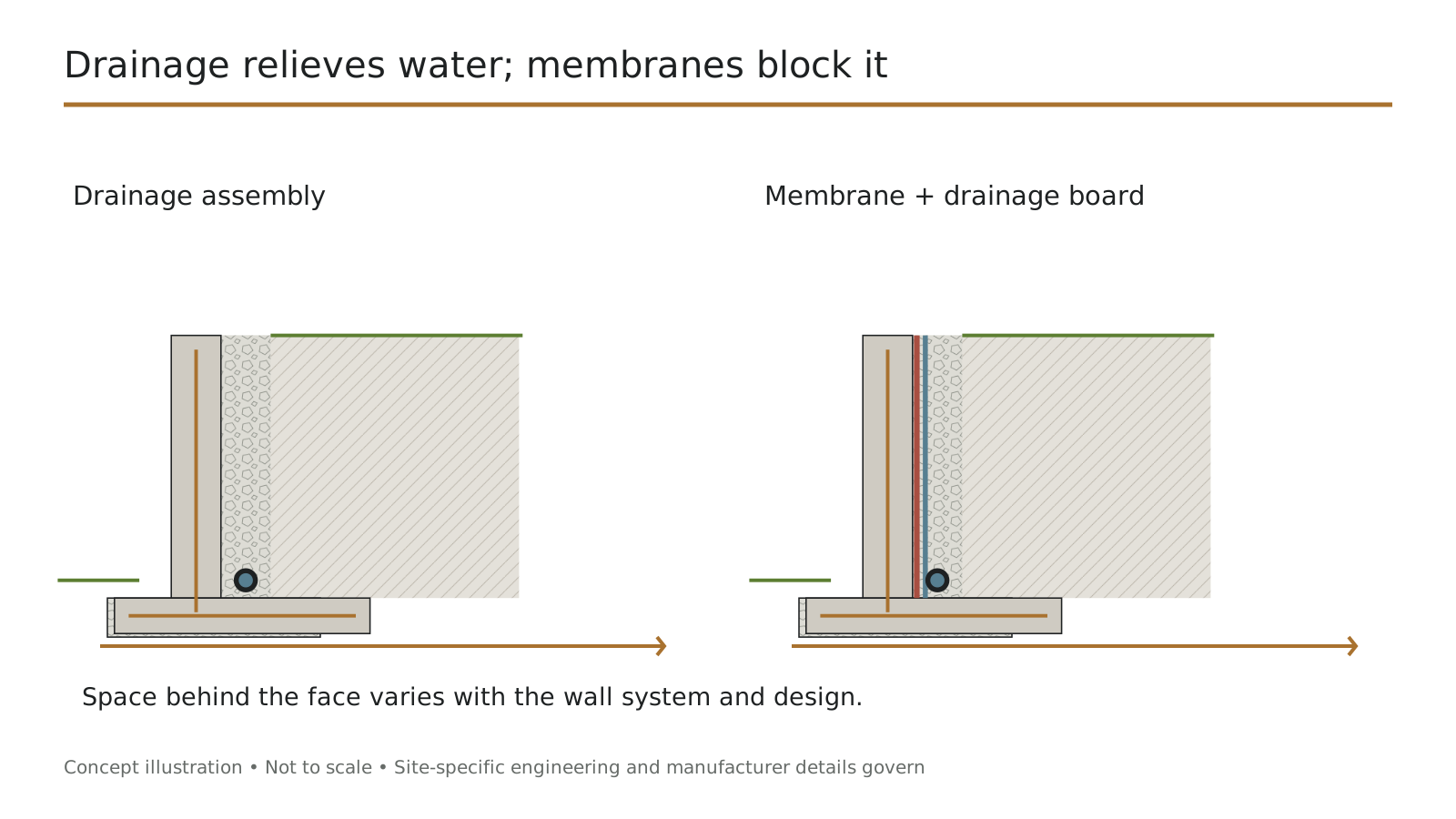
- Drainage relieves pressure. It gives water a path to somewhere else so it never builds up against the wall. Aggregate, filter separation, pipe and an outlet. Every wall needs this.
- Waterproofing blocks passage. A membrane on the back face stops moisture moving through the wall to the dry side. It does nothing about pressure, which is why it is installed alongside drainage rather than instead of it.
Retaining Wall Waterproofing cost
| Scenario | What it covers | Planning range | Notes |
|---|---|---|---|
| Fluid-applied membrane, new construction | Applied to back face as wall rises | $2 – $6 / sq ft | Simplest assembly, good for regular surfaces |
| Sheet membrane, new construction | Self-adhered sheet system | $4 – $8 / sq ft | More robust, better at detailing around penetrations |
| Membrane plus drainage composite | Full assembly with pressure relief | $6 – $10 / sq ft | The specification for anything behind habitable space |
Planning ranges based on published 2026 national cost averages for comparable work (HomeGuide, HomeAdvisor), not quotes. Access to the back face drives retrofit pricing. Last reviewed: September 2026.
What to plan around
A waterproofing assembly is four components that only work together, and the fourth one is the one that gets forgotten.
- Membrane. The barrier itself, on the back face, continuous and correctly terminated.
- Drainage board or composite. Protects the membrane during backfill and gives water a defined vertical path rather than letting it pond against the barrier.
Is water coming through your wall?
Contact us today to schedule a free on-site retaining wall drainage estimate. The outlet is the first thing we check, and clearing it is often the whole fix.
Start your free retaining wall drainage estimate or call (804) 409-8197
Choosing Drainage Materials & a Suitable Discharge Route
A wall drainage system has four parts, and the fourth, a working discharge route, is the one that gets skipped. Clean stone, filter fabric and perforated pipe do nothing if the water has nowhere to go. We confirm the outlet before choosing materials.
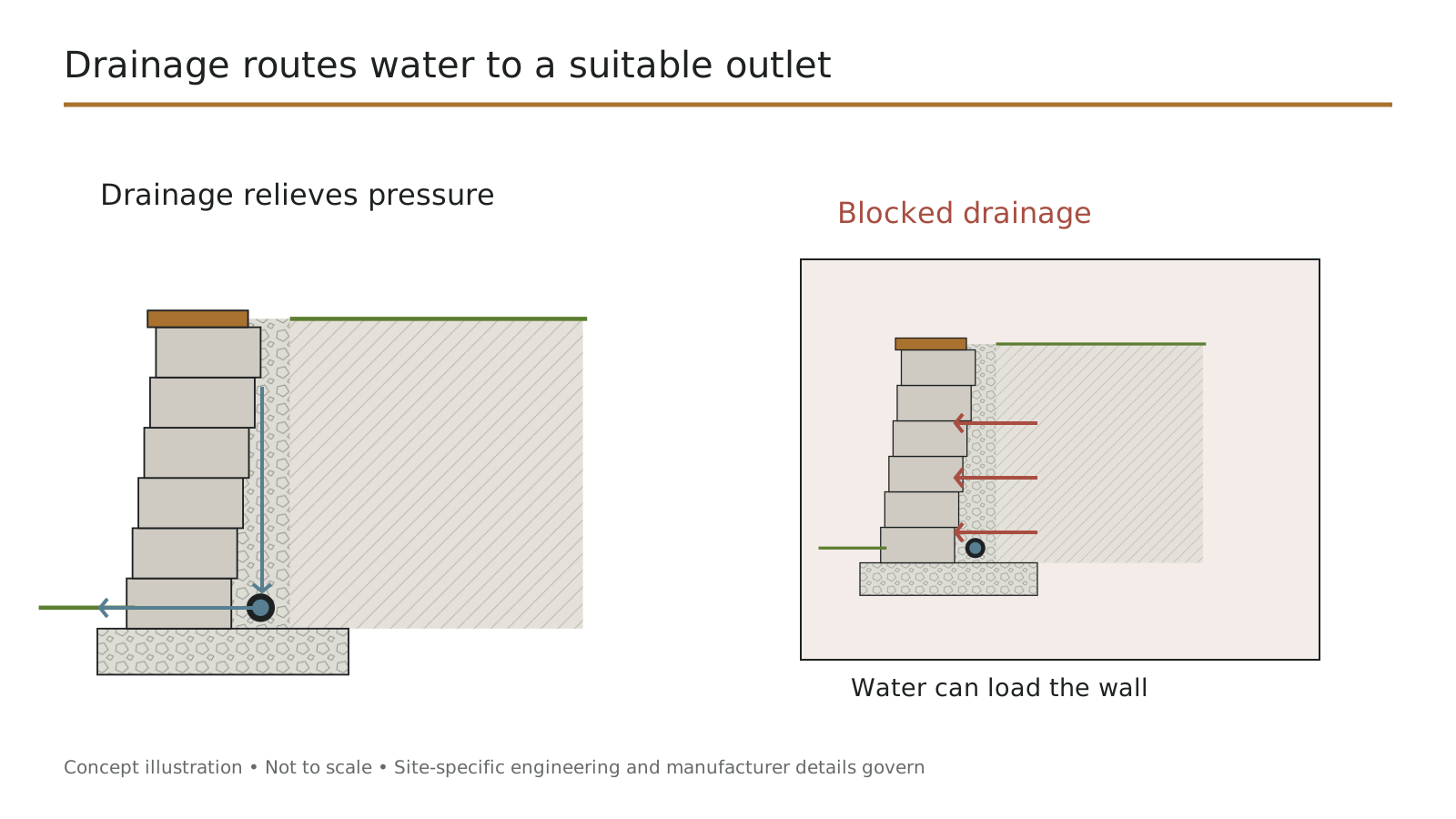
- The aggregate zone. Clean, angular, open-graded stone directly behind the wall face gives water somewhere to go instead of into the soil mass. It has to stay clean to keep working, which is what the next part is for.
- Filter separation. Geotextile between the retained soil and the aggregate stops fines migrating in and clogging the voids. This is the component most commonly left out, and the omission takes years to show up. By then it looks like a wall problem.
Retaining Wall Drainage Installation & Repair Costs in Richmond, VA
Cost turns almost entirely on access. Installing drainage as part of a new wall is inexpensive. Retrofitting it into a wall that is already standing is not.
| Scenario | What it involves | Planning range | Notes |
|---|---|---|---|
| Drainage with new wall construction | Built in as the wall goes up | Included in wall pricing | By far the cheapest time to do it right |
| Outlet clearing and re-establishment | Locating, clearing, re-daylighting | $350 – $1,200 | Often the entire fix when the system was built correctly |
| Retrofit, accessible from behind | Excavate behind wall, add system, backfill | $45 – $110 per linear foot | Requires machine access and open ground above |
| Retrofit, wall opened | Partial removal, system installed, wall rebuilt | $40 – $100 per face sq ft | When the back of the wall cannot be reached |
| Dry well or pumped discharge | Where no gravity outlet exists | $1,200 – $5,000 | Common on flat Coastal Plain lots |
Why retrofits cost what they cost
The drainage components themselves are a small fraction of a retrofit. What you are paying for is getting to the back of a wall that was built without it, supporting the retained soil while that happens, and putting everything back. When a new wall is going in anyway, drainage is close to free by comparison. That is the strongest argument for doing it properly the first time.
How We Investigate & Correct Drainage Problems
- 1
Find the outlet, or confirm there is not one
This answers most of the question. A silted outlet is a cheap fix. No outlet at all is a different project.
- 2
Trace the water source
Roof discharge, uphill runoff, subsurface flow and irrigation all behave differently. Fixing the source is often cheaper than handling the volume.
- 3
Check available fall
We shoot elevations from the wall to every candidate discharge point. On flat lots this step decides the entire design.
- 4
Choose the access route
Excavating behind the wall preserves the face. Opening the face is sometimes the only way in. We tell you which one your site allows and why.
When Drainage Work Requires Opening the Wall
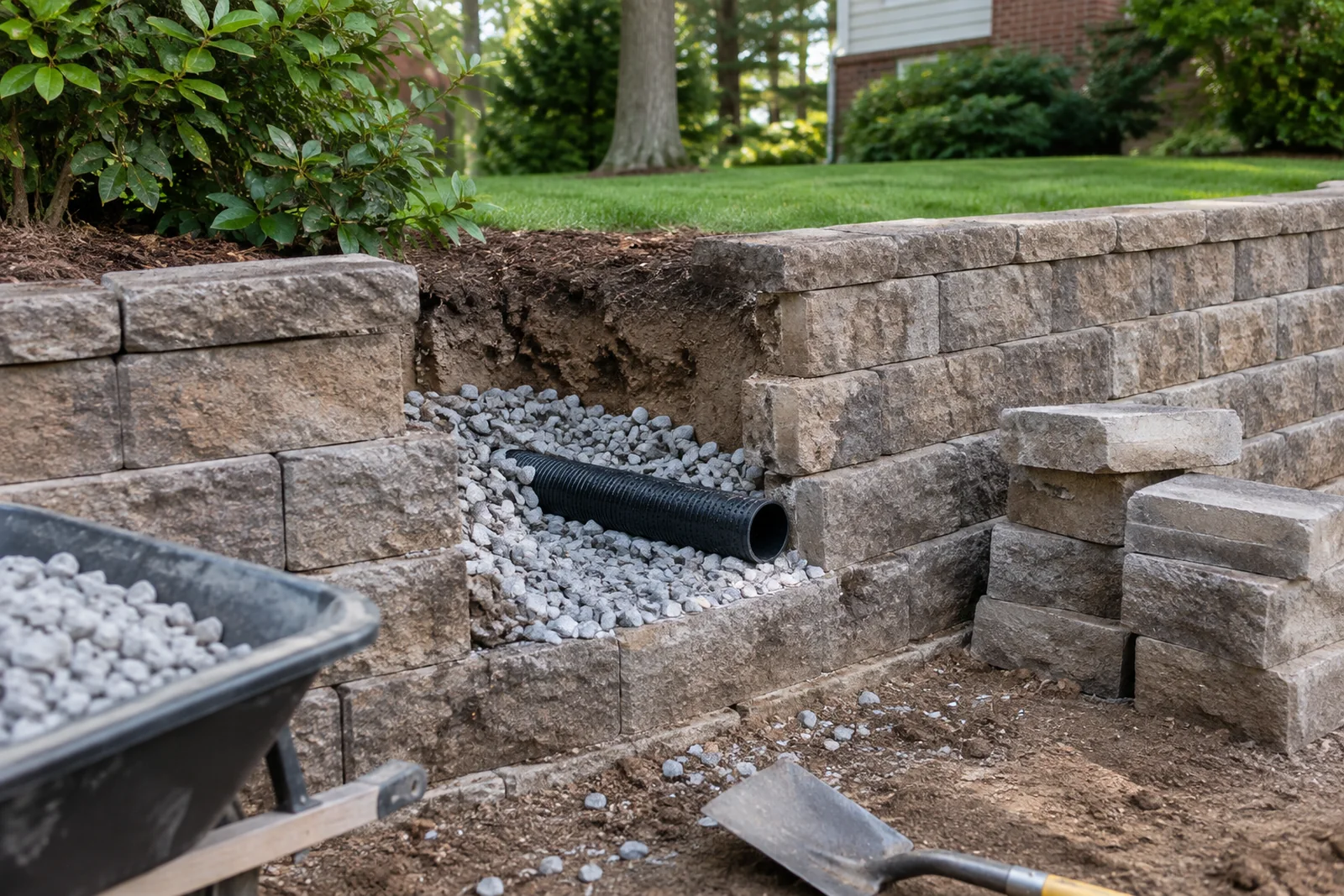
- Open ground behind the wall. Lawn or beds above and behind the face means we can usually excavate from the back, install the system and backfill without touching the visible wall.
- Hardscape behind the wall. A patio, driveway or parking area above the wall changes the arithmetic. Removing and reinstating that surface can cost more than opening the wall face.
Local Stormwater & Drainage Discharge Requirements
- Land disturbance thresholds. Virginia regulates land-disturbing activity at 10,000 square feet in most areas, and at 2,500 square feet in areas designated as Chesapeake Bay Preservation Areas. Localities may set lower thresholds. Long drain runs cross these more easily than people expect.
- Resource protection buffers. Chesapeake Bay Preservation Area rules apply buffers along waterways in designated Tidewater localities. Several jurisdictions here are affected and several are not, so we check by address rather than assuming.
Every threshold and buffer on this page is the state framework. Your locality administers it and can be stricter. We verify with the actual office for your address before work starts, and our permits guide lists who that is by jurisdiction.
Retaining Wall Drainage & Waterproofing FAQs
Why does drainage matter more on one side of Richmond than the other?
Piedmont clay west of the Fall Line holds water against a wall for days after a storm. Coastal Plain sand to the east drains fast but migrates into unfiltered stone, so the two sides need different aggregate and filter fabric.
Is there always somewhere for the water to go on flat Richmond-area lots in Sandston or Highland Springs?
Not always. Flat, low-lying lots sometimes have no gravity outlet at all, and we check elevations before promising a design rather than after.
Are weep holes enough on their own?
Usually not. Weep holes give water a way out of the face, but they do nothing to collect it or to keep soil from migrating into the aggregate and clogging the path.
Can drainage be added without removing the wall?
Sometimes. If we can reach the back of the wall by excavating behind it, we can retrofit without touching the face.
What if there is nowhere for the water to go?
This is the real constraint on flat lots in Sandston, Highland Springs and parts of Mechanicsville. If nothing downhill daylights, the options are a dry well sized to the volume, a pumped system, or re-routing to a point on the property that does have fall.
Can drain water be discharged onto my neighbor's property?
Concentrating and directing water onto adjacent land can create liability, and local rules vary. We look for a discharge point that works legally and practically, which sometimes means a longer run than the shortest line downhill. See our permits and requirements guide.
How long does wall drainage last?
A properly filtered system with a maintained outlet can run for decades. What kills it is silt.
Request a Free Retaining Wall Drainage Estimate
- Outlets found and cleared
- Filter fabric in every system
- Waterproofing where needed
- Legal discharge routes