
Erosion Control Richmond: Slope Stabilization Options for Your Property
Gullies after storms, exposed tree roots, soil washing onto the driveway, mulch disappearing every spring, bare patches that will not hold grass, and a slope migrating steadily toward something you care about. These are the symptoms.
- Erosion is a water problem before it is a soil problem
- Methods differ in cost by an order of magnitude, so diagnosis matters
- A wall built without addressing the water source fails the way the slope did
- Slope work crosses land disturbance thresholds more readily than flat work
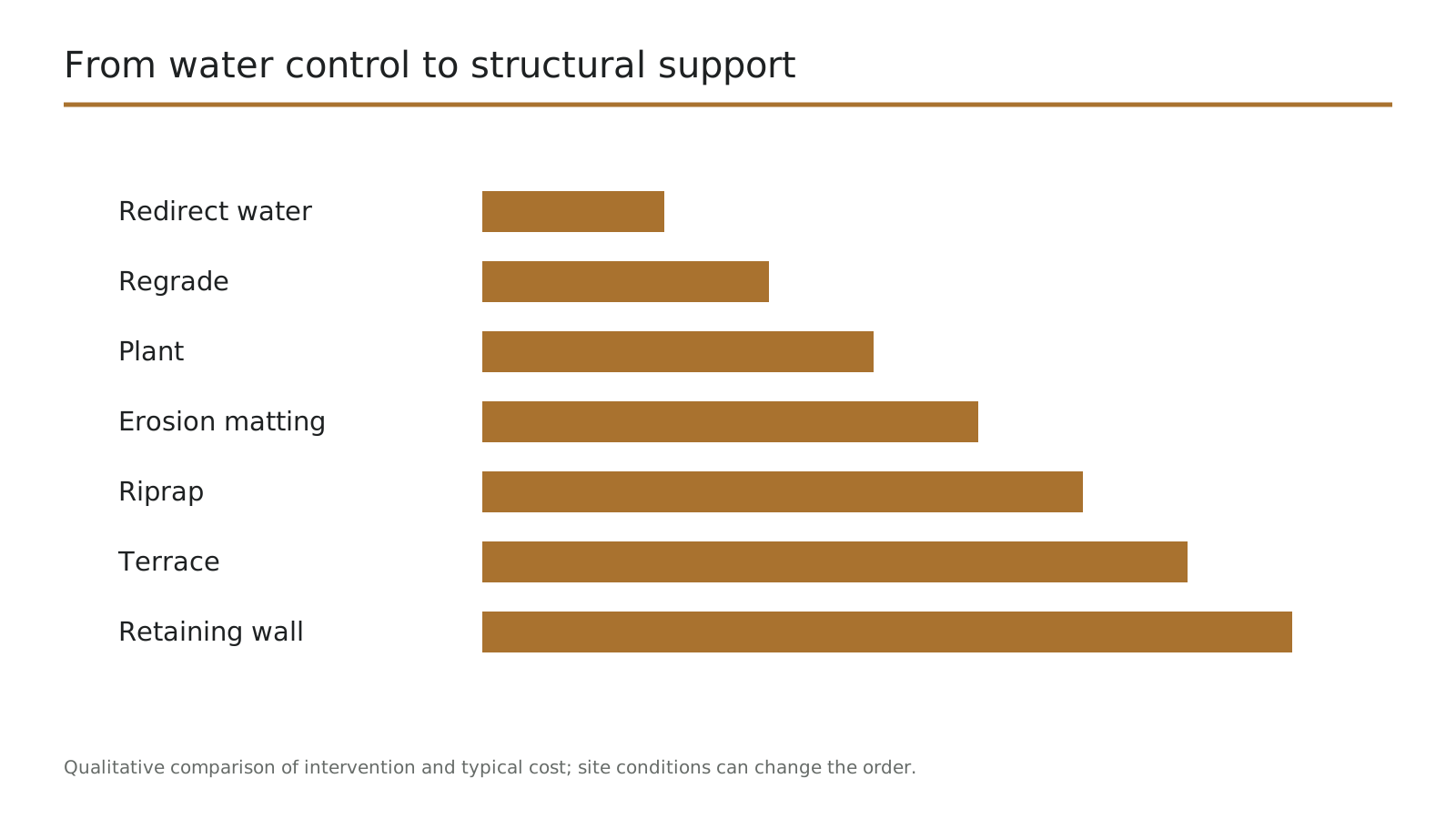
The intervention range runs from least to most invasive. Redirecting the water source. Regrading and diverting runoff. Vegetative cover and deep-rooted planting. Erosion control blanket and matting. Riprap and armouring. Terracing. And finally structural retaining walls.
We find where the water is coming from before recommending anything. A wall installed without addressing an upstream water source fails the same way the slope did, just more expensively.
Losing yard every storm?
Contact us today to schedule a free on-site erosion control estimate. Tell us where the water comes from and after what kind of rain.
Start your free erosion control estimate or call (804) 409-8197
Identifying the Water Source, Slope Conditions & Soil Behavior
A few site facts decide which method suits your slope, and none of them is how the slope looks. Where the water starts, how steep the ground is and how the soil behaves all change the answer. We start with the lightest fix that works, and walls come last.
- Where the water originates. Roof discharge, an uphill neighbor's runoff, a driveway or road surface, a spring, or simply rainfall on the slope itself. Each needs a different response and they are not interchangeable.
- How much arrives, and how fast. A slope shedding its own rainfall is a different problem from one receiving concentrated runoff from half an acre of pavement. Volume and velocity determine whether vegetation can hold.
- Slope angle and length. Steeper and longer means faster water and more energy to dissipate. Long slopes frequently need interruption partway down rather than treatment only at the bottom.
- Soil behavior. Piedmont clay west of the Fall Line detaches differently from Coastal Plain sand east of it. Sand moves readily and clay holds until it saturates and then moves in quantity.
- What is already growing. Existing root systems are doing work. Preserving them is cheaper than replacing them, and clearing a slope before stabilizing it usually makes the problem worse first.
- What is at risk. A slope eroding toward a foundation, a driveway or a property line changes the urgency and frequently the method.
Erosion Control & Slope Stabilization Costs in Richmond, VA
Erosion work is priced by method and area rather than as a single project number, because the methods differ enormously in cost. This is why diagnosis matters more here than on almost any other page.
| Method | What it suits | Planning range | Notes |
|---|---|---|---|
| Water diversion and regrading | Where the problem is where water goes | $0.40 – $2.00 / sq ft | Frequently the cheapest real fix |
| Erosion control matting and seeding | Moderate slopes, moderate water | $1.50 – $4.00 / sq ft | Takes seasons to establish fully |
| Deep-rooted planting scheme | Long-term surface stabilization | $2.00 – $6.00 / sq ft | Slow, effective, low maintenance once established |
| Riprap and armouring | Concentrated flow, channel edges | $85 – $200 / ton installed | Stone size set by expected flow |
| Terracing | Long slopes needing interruption | $35 – $75 / face sq ft | Cross-refer to the wall system used |
Planning ranges based on published 2026 national cost averages for comparable work (HomeGuide, HomeAdvisor), not quotes. Method selection moves the total far more than area does. Last reviewed: September 2026.
How We Stabilize the Slope From Water Control to Final Ground Cover
- 1
Walk the slope and trace the water
Uphill of the problem, not just at it. Most erosion originates above where it becomes visible.
- 2
Assess volume, angle and soil
How much water arrives, how fast, across what gradient, and how the soil here behaves when saturated.
- 3
Address the source first
Redirecting or reducing the water reaching the slope is almost always cheaper than engineering the slope to survive it.
- 4
Shape the ground
Regrading, diversion swales and interruption partway down long slopes.
- 5
Install the chosen system
Matting, riprap, terracing or structure, sized to the water the slope actually receives.
- 6
Establish ground cover
Seeding or planting, with temporary protection while roots establish. This is the part that takes seasons rather than days.
- 7
Temporary erosion control during works
Silt protection and stabilization while the ground is open. Required on most regulated slope work and sensible regardless.
- 8
Follow-up
Vegetation-based work benefits from a check after the first full wet season. We tell you what to look for.
Combining Vegetation, Matting, Riprap & Structural Walls
Most slopes that actually get fixed use more than one method. They work at different scales and on different timelines.
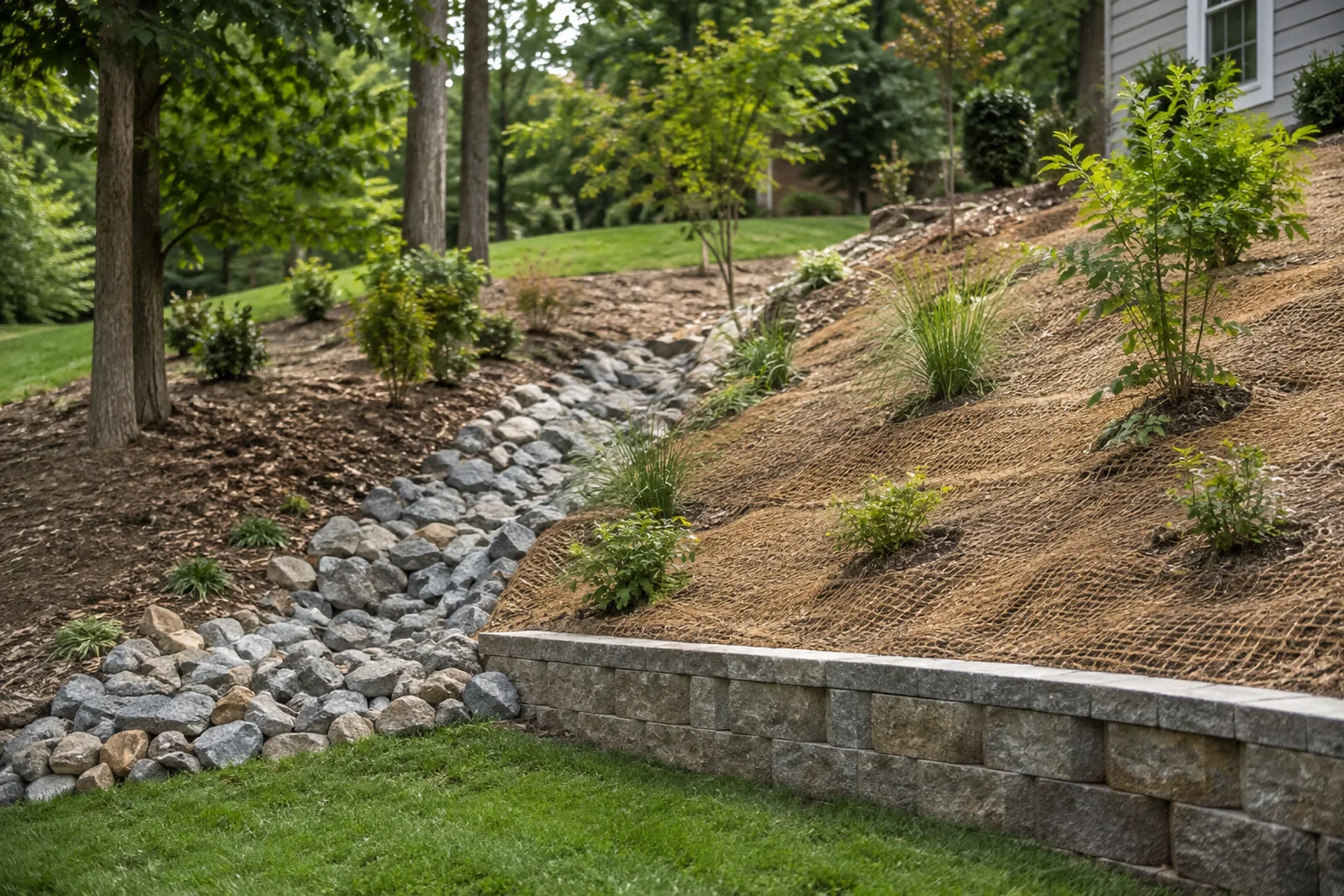
- Vegetation is the long game. Deep root systems bind soil permanently and cost very little to maintain. They also take seasons to establish, during which the slope is still vulnerable.
- Matting bridges the gap. Erosion control blanket holds soil in place while roots establish, then degrades or becomes part of the surface. It is what makes vegetation viable on a slope that is currently moving.
- Riprap handles concentrated flow. Where water is channelled rather than sheeting, armouring dissipates energy that vegetation cannot survive.
- Terracing interrupts length. Breaking a long slope into shorter sections reduces the velocity water can build. Frequently cheaper than one tall structural wall.
- Walls hold grade. Where the ground has to be at two different levels, nothing else does the job. See retaining wall installation for wall-led hillside projects.
- Drainage underpins all of it. Subsurface water moving through a slope undermines every surface treatment. See drainage.
Erosion & Sediment Control Permits and Land Disturbance Rules in Richmond, VA
Slope work crosses regulatory thresholds faster than most residential jobs, because area adds up quickly on a hillside. Virginia regulates land disturbance above 10,000 square feet, and above 2,500 square feet inside Chesapeake Bay Preservation Areas. We check which rules apply to your address before any soil moves.
- Land disturbance thresholds. Virginia regulates land-disturbing activity at 10,000 square feet generally and at 2,500 square feet in areas designated as Chesapeake Bay Preservation Areas. Localities may set lower thresholds.
- Why slope work crosses them. Stabilising a hillside frequently disturbs more area than building a house extension. Area is measured across the whole worked surface, not just where structure goes.
- Resource protection buffers. Chesapeake Bay Preservation Act rules restrict land disturbance close to designated waterways in designated localities. Eroding slopes are frequently near water, which is part of why they erode.
- Temporary measures during works. Regulated slope work generally requires silt protection and stabilization while ground is open, and that is a line item.
- Building permits. The Virginia Uniform Statewide Building Code exempts retaining walls supporting less than three feet of unbalanced fill from permit application. The exemption does not apply where the wall supports a surcharge other than ordinary unbalanced fill. Where a structural wall is part of the solution, that threshold applies to it.
- Uphill runoff. Where the water originates on someone else's land, the practical and legal position is worth understanding before you spend money managing somebody else's runoff.
We confirm current thresholds with the building office for your address before quoting. Detail by jurisdiction is on our permits and requirements page.
Erosion Control & Slope Stabilization FAQs
Where does erosion work come up most in the Richmond metro?
Wooded slopes in Bon Air and Brandermill, and creek-corridor lots in Chester, where runoff concentrates as it heads toward Proctors Creek or Swift Creek.
Do Chesapeake Bay Preservation Areas affect Richmond-area erosion work?
Yes, designated localities apply a lower land disturbance threshold near waterways, which we check before scoping any slope project.
Will planting alone stop the erosion?
Sometimes, and it depends on how much water arrives and how fast. Vegetation binds soil permanently and cheaply, and it takes seasons to establish.
Do I need a retaining wall or just regrading?
Regrading solves problems of where water goes. A wall solves problems of where ground has to be.
What happens if I leave it another season?
Erosion accelerates, because each event removes the material that was protecting what is underneath. A gully that is shallow this year channels more water next year.
The runoff is coming from my uphill neighbor. Who is responsible?
That is a legal question rather than a construction one, and it depends on whether the flow is natural drainage or has been concentrated by something they built. We will tell you what we can see about the source.
How long before new vegetation actually holds the soil?
Surface cover establishes within a season. The deep root systems that genuinely bind a slope take considerably longer, often two to three growing seasons.
Request a Free Erosion Control Estimate
We start with the cheapest fix that will actually hold. We measure the site, explain what the ground needs, and give you a written price with every line item shown.
- Water source found first
- Matting, riprap and planting
- Walls only when needed
- Erosion permits handled
Serving Richmond, Henrico, Chesterfield and Hanover, plus Petersburg, Hopewell, Colonial Heights, Powhatan, Goochland and Prince George County.